
Clawdbot (Moltbot / OpenClaw): The Definitive Guide to the AI Agent That Is Redefining Autonomous Intelligence in 2026
A complete guide to Clawdbot (Moltbot / OpenClaw), the autonomous AI agent transforming automation in 2026. Learn how it works, its risks, competitors, and market impact.
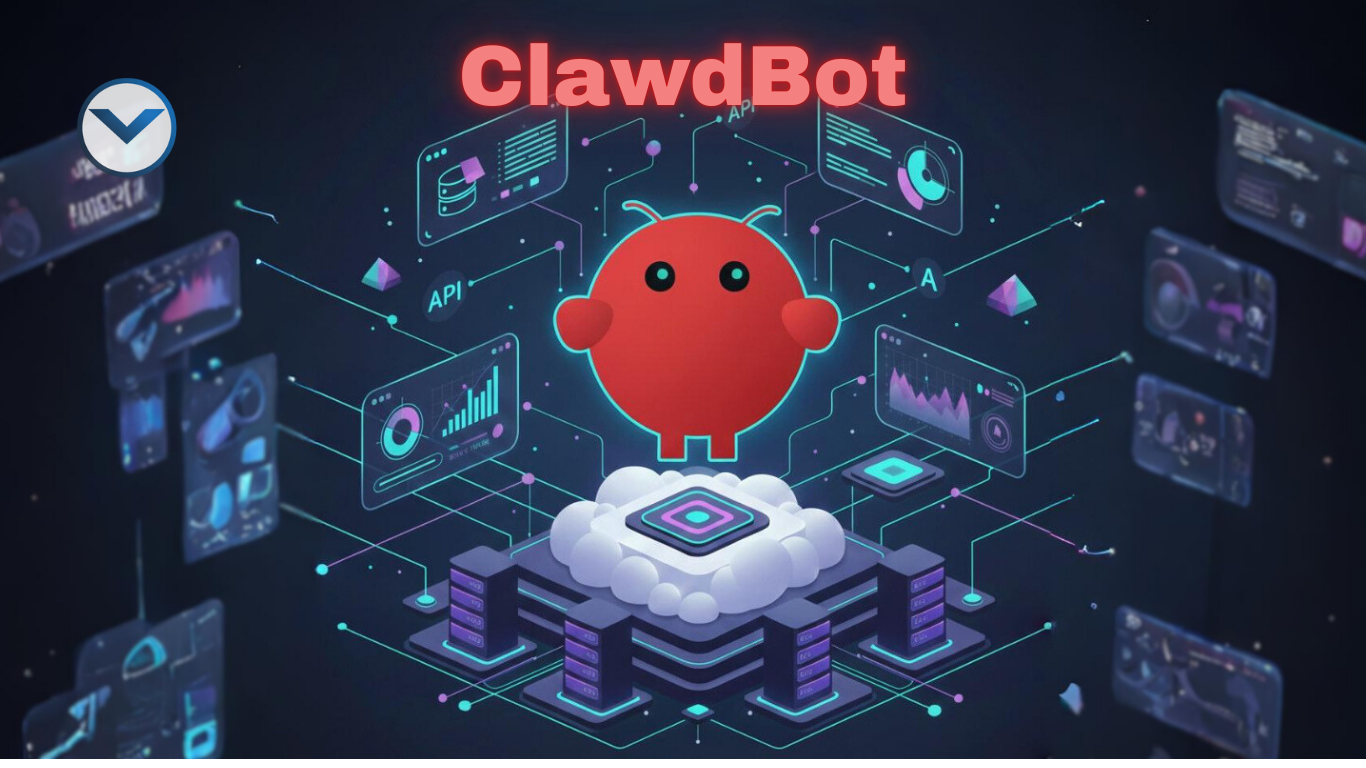
Artificial intelligence has moved beyond answering questions and generating content. In 2026, the focus has shifted toward autonomous AI agents capable of planning, executing, remembering, and improving workflows without continuous human intervention. Among all emerging agent platforms, Clawdbot, now known as Moltbot and increasingly referred to as OpenClaw, has become the most discussed, most debated, and most influential project in this space.
This article is a complete, end-to-end analysis of Clawdbot, designed to answer every major question surrounding the platform: what it is, how it works, why it exploded in popularity, how it compares to competitors, its financial trajectory, security risks, market impact, and why it represents a structural shift in how humans and software interact.
1. What Is Clawdbot?
Clawdbot is an open-source autonomous AI agent framework that allows users to deploy a persistent, self-hosted AI assistant capable of executing real actions across systems, applications, and communication channels.
Unlike traditional AI chat interfaces, Clawdbot is designed to operate continuously, maintain long-term memory, and proactively act on user intent. It can read and write files, execute scripts, automate browsers, respond across messaging platforms, and coordinate multi-step workflows with minimal supervision.
Official project resources:
https://github.com (search: OpenClaw / Moltbot)
At its core, Clawdbot represents a shift from conversational AI to agentic AI systems that behave less like tools and more like digital operators.
2. The Vision Behind Clawdbot
The foundational idea behind Clawdbot is simple but radical:
AI should not wait for instructions, it should manage outcomes.
Most existing assistants rely on short-term context windows and user-initiated prompts. Clawdbot was designed to behave more like a digital chief of staff, capable of remembering goals, tracking progress, and executing tasks autonomously.
This philosophy aligns with broader industry trends described by OpenAI, Anthropic, and Microsoft, where the future of AI is agent-driven rather than prompt-driven:
3. Evolution and Name Changes: From Clawdbot to Moltbot to OpenClaw
3.1 Why the Name Changed
The project was originally released as Clawdbot, a name that referenced Anthropic’s Claude ecosystem and mascot imagery. As adoption accelerated, legal concerns emerged around trademark similarity.
To avoid prolonged disputes, the project was renamed Moltbot, symbolizing growth and transformation through shedding old constraints. The name change was widely discussed across developer communities and amplified the project’s visibility rather than harming it.
Today, documentation increasingly references OpenClaw a neutral, open-source-friendly identity that reflects the project’s broader ambitions beyond a single model or vendor.
This evolution highlights an important theme: the project outgrew branding concerns faster than anticipated, a signal of real market traction.
4. How Clawdbot Works: Architecture Overview
Clawdbot is not a single model or service. It is a framework composed of several core layers:
4.1 Reasoning Layer
Powered by large language models such as Claude, GPT-4-class systems, or local LLMs via Ollama. This layer handles planning, interpretation, and decision-making.
4.2 Memory Layer
Clawdbot uses vector-based long-term memory to store contextual information, preferences, historical actions, and ongoing goals. This allows continuity across days or weeks.
4.3 Execution Layer
The agent can run shell commands, interact with browsers, manipulate files, and trigger workflows. This is what transforms it from a chatbot into an operator.
4.4 Integration Layer
Native support exists for messaging platforms, APIs, and third-party services, allowing Clawdbot to live where users already work.
This architecture is what enables persistent autonomy, a capability missing from most mainstream assistants.
5. Installation and Deployment Guide (Practical Overview)
Clawdbot is designed primarily for technical users, startups, and automation-driven teams.
A typical deployment involves:
Preparing a local machine or VPS with Node.js and Python.
Installing the agent via CLI.
Connecting an AI model provider or local LLM.
Enabling messaging integrations.
Hardening security through authentication and network controls.
Official documentation:
https://docs.expo.dev (for mobile-agent integrations)
While installation is straightforward for engineers, non-technical users often rely on managed setups or third-party services.
6. Core Use Cases Across Industries
Clawdbot’s flexibility makes it applicable across domains:
6.1 Personal Productivity
Users deploy Clawdbot as a persistent assistant that manages schedules, reminders, communications, and research.
6.2 Software Development
Engineering teams use it to monitor repositories, automate testing, deploy builds, and summarize pull requests.
6.3 Business Operations
Clawdbot can coordinate internal workflows, generate reports, monitor KPIs, and manage internal communications.
6.4 Research and Knowledge Management
Its long-term memory makes it ideal for tracking research projects, academic notes, and evolving documentation.
This breadth is why Clawdbot is often described as a general-purpose cognitive worker rather than a niche automation tool.
7. Competitive Landscape: Why Clawdbot Is Different
7.1 Compared to ChatGPT and Claude
Mainstream assistants are cloud-hosted, session-based, and reactive. Clawdbot is self-hosted, persistent, and proactive.
7.2 Compared to Auto-GPT and BabyAGI
Earlier agent projects focused on experimentation. Clawdbot emphasizes operational stability, extensibility, and real-world execution.
7.3 Compared to Enterprise Automation Tools
Traditional RPA tools require predefined workflows. Clawdbot dynamically reasons and adapts based on context.
This distinction has caused several early agent frameworks to lose mindshare as developers consolidate around Clawdbot’s more mature design.
8. Financial Analysis and Market Projections
8.1 Current Financial Model
Clawdbot itself is open source, but an ecosystem has formed around it:
Paid hosting and setup services
Enterprise support offerings
Premium plugins and integrations
Training and consulting services
This mirrors the monetization paths of Linux, Kubernetes, and Elasticsearch.
8.2 Market Size Projection
According to multiple AI industry forecasts, the AI agent market is expected to exceed $50–70 billion by 2030, driven by enterprise automation and productivity tools.
Given Clawdbot’s early dominance in open-source agents, a conservative projection suggests:
Tens of thousands of active deployments by 2027
A service ecosystem generating hundreds of millions in annual revenue
Enterprise adoption as regulated, sandboxed versions mature
This positions Clawdbot not as a product, but as infrastructure.
9. Security Risks and Ethical Concerns
Power comes with risk.
Because Clawdbot can execute code and access system resources, misconfiguration can lead to serious vulnerabilities. Security researchers have warned about:
Exposed control panels
API key leakage
Prompt injection attacks
Malicious third-party plugins
Authoritative security analysis:
https://www.techradar.com/security
These risks are not flaws unique to Clawdbot but inherent to agentic AI systems. Proper isolation, sandboxing, and access controls are mandatory for production use.
10. Social Media Hype and the Rise of Agent Communities
Clawdbot’s growth was accelerated by social platforms like X (Twitter), Reddit, Discord, and LinkedIn. Developers shared real-world use cases, productivity gains, and experiments, creating a feedback loop of visibility and adoption.
Notably, AI agents themselves are now being deployed to manage social presence, giving rise to the concept of AI-managed digital identities, a trend expected to grow significantly.
11. Impact on the AI Market
Clawdbot has shifted industry conversations in three major ways:
From prompts to autonomy
From cloud dependency to self-hosting
From assistants to operators
Many competing agent projects lost relevance as Clawdbot set a new baseline for what an AI agent should do.
12. Final Assessment: Why Clawdbot Matters
Clawdbot is not just another AI tool. It is an early blueprint for how software will work alongside humans in the next decade.
It demonstrates both the promise and the danger of autonomous AI, forcing the industry to confront questions around control, security, and responsibility.
For businesses, developers, and researchers, understanding Clawdbot is no longer optional. It represents a turning point the moment AI stopped waiting for instructions and started managing outcomes.
Tagged with:
Recent Articles
View All
The Future of AI-Powered Development
Explore how artificial intelligence is revolutionizing the software development lifecycle and what it means for developers and businesses.
Building Design Systems That Scale
Learn best practices for creating and maintaining design systems that grow with your organization.

Making Data-Driven Decisions in Enterprise
A practical guide to implementing data analytics strategies that drive real business value.
Never Miss an Update
Subscribe to our newsletter and get the latest insights delivered directly to your inbox